Frequently Asked Questions
Do I really need a whole wardrobe of khaki colored clothes for safari?
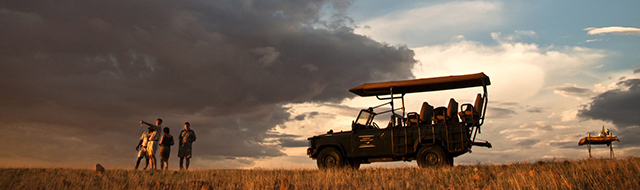
No. When you are on game drive, the animals can't see you for what you are, they see you as part of the vehicle (which they ignore), so the color of your clothing is not terribly important. When you are walking though (and virtually every safari camp offers an opportunity for walking), the animals do see you, and you want to wear neutral colored clothes that blend into the environment. This is where the khakis, tans, and/or light browns are important.
So, our advice is to take at least one set of clothes in these colors to maximize your enjoyment on walks. We think that part of the fun of safari is playing and looking the part, so we do encourage clients to try and take clothes that are in keeping with the 'spirit' of safari (and most travelers follow this philosophy). But, in terms of what you "need", we would say just one set of neutral color clothing for walking will suffice.
Can I take a roller-bag on safari?
The reason the charter companies want bags with all soft sides is because the luggage pods on the planes are small and have small entrances, and they need to be able to squeeze and manipulate the bags to fit them into the pod. The problem with roller-bags, even if they fall within the allowed dimensions, is that their hard sides limit the extent to which they can be manipulated into available spaces.
Some charter companies do allow wheeled duffel bags, with a rigid base and all other sides being soft, as long as they fall within specified dimensions - please consult your packing advise for guidance on acceptable wheeled duffel bags.
Travelers do sometimes "get away with" luggage that has hard sides and/or is overweight, but we advise against taking this risk. If your bag doesn't fit conveniently in the luggage pod, the charter company could require you to purchase a duffel bag, transfer all your belongings to the new bag, and jettison your wheeled luggage at the airport; all while the other (onlooking) passengers are waiting impatiently for the flight to depart. Not all charter companies are equally strict in enforcing this requirement, and we'd be happy to discuss the nuances in more detail on the phone, but our formal advice is to keep things simple and use a soft-sided duffel bag - there are very few instances once you are on safari that you will actually have to carry it.
My body weight is well below the maximum limit, can I take extra luggage?
No. The charter companies work on an average adult weight of 154lbs per passenger on each charter flight. They assume that some passengers are going to weigh less and some are going to weigh more. Based on this average, they determine how much luggage each passenger can safely bring on the flight with them, and this is then the allowance given to everyone.
Individuals weighing more than 220lbs need to let us know in advance as they may be required to purchase an extra seat on the charter flights.
How strict are the charter companies with their luggage weight limits?
Please bear in mind that the luggage limits imposed by the charter companies are for safety reasons and are generally strictly enforced.
Bags are not always weighed - it's only when you are flying from an airport that scales are available to weigh bags, and luggage on flights from one camp airstrip to another does not get weighed. Occasionally pilots are a bit lenient and will allow a couple of extra pounds, but we advise adhering to the weight restrictions.
Clients are sometimes upset because they encounter travelers whose bags are clearly overweight and who "get away with it." From our perspective, it is not worth taking chances. Overweight luggage normally gets discovered somewhere in the course of your travels, and you are then faced with the unpleasant choice of jettisoning belongings or paying a steep fee to buy an extra seat on flights.
Your packing guidelines should enable you to comfortably meet the weight limits, and we are happy to talk you through your luggage item by item to narrow it down to what you really need. If you would like to explore the possibility of storing excess luggage while on safari, please reach out to us.
Do I need to take hiking boots on safari?
No, any comfortable walking shoes will suffice (including sneakers, running shoes, etc.). The amount of walking that you will do and the type of terrain that you will cover require only comfortable walking shoes. There is the aesthetic question of what type of footwear will look appropriate on safari, but that is a personal assessment (like the khaki clothing).
If you have appropriate boots (lightweight, cool, and well broken-in), by all means take them, but you don't have to go out and buy them. Do not take heavy boots with Thinsulate, Gortex, or other warm/non-breathable linings as your feet will be hot and uncomfortable.
We also recommend a pair of lightweight, sturdy sandals for relaxing at camp over the midday period.
Can I recharge batteries at the safari camps?
Yes, all permanent tented camps and lodges have facilities for charging batteries, mostly in the rooms but sometimes in the common areas. You might want to take your own adapter plugs (refer to Electricity and Adapters) in case the one in your room is not working properly (and to allow you to charge more than one device at a time).
How much cash should I take?
Safari camps and lodges are typically all inclusive, and any extras can always be put on a credit card (Visa and Mastercard, sometimes Amex). Your only cash requirements on safari are for visa fees, departure taxes, gratuities, and shopping at informal markets. For guidance, please refer to the cash and gratuity guidelines that will available roughly 60 days before your safari on your Downloads page.
Can I communicate with the outside world while on safari?
Almost all safari camps feature internet connection. It is typically too slow for downloading movies or video-conferencing, but it is fine for email and voice-over-internet calls. If you don't already have an app that will allow you to make internet-based calls on your phone, then we recommend that you look into options like Whatsapp or Skype, to be able to stay in touch with family or work while on safari (if you want to!).
If you need guaranteed reliable communication with the outside world throughout your journey, consider renting a satellite phone (please be in touch if you would like additional information).
Should I take electronic equipment?
In our opinion, the less electronic equipment you take on safari the less distracted you will be, and the more you will enjoy your experience of the African wilderness. The combination of soft bags, rough handling, and fine African dust is hard on fragile electronic devices.
Smart phones and tablets can be useful for reading (or entertainment) on the long international flights to/from Africa, and smart phones make excellent "point and shoot" cameras. They can also be used for email and voice-over-internet calls (see above). The device(s) should be kept with you in your carry-on luggage at all times.
Should I bring gifts for the local people?
The vast majority of safari camps that we work with have partnerships with their local communities, and frequently fund and manage community upliftment projects (schools, clinics, water purification, etc.) - by far the most meaningful gift that you can give would be a donation to these projects. We understand that travelers sometimes would like to gift something more personal and, in these instances we recommend things that are light and easy to pack, and will be beneficial to the recipients - for example, school supplies (pens, pencils, notepads, calculators, etc.), and solar inflatable lanterns (e.g. Luci Lights).
Can I take ziplock bags on safari?
Most African countries have banned plastic bags, and we recommend against taking single-use plastic shopping bags. Although there is no official exception, we have encountered no problems with ziplock bags (or similar multiple-use plastic bags), which can be useful for toiletries and/or LAGs in carry-on luggage for international flights.
Should I take my own water bottle on safari?
No, it is not necessary as the safari camps will provide you with high-quality water bottles. They make nice, keep-sake souvenirs from your safari.
Can I change guide / vehicle on safari?
The quality of guides at the safari camps and lodges that we work with is of the highest order, and the most frequently listed safari highlight from returning clients is the standard of guiding in the course of their trip. It's very rare, but there may be instances where, for whatever reason, you don't "gel" with a particular guide or other guests on your safari vehicle - if this happens, and you would like to try a different guide/vehicle, please subtly let the camp manager know and they will try to move you. This isn't always possible, but there is no harm in asking - the manager will handle the situation with requisite sensitivity.