Recommended Packing List
General
With all of these considerations in mind, here is a list of items that we would recommend taking:
- Passports
- Pre-arranged visas (if needed) - please see your itinerary for information.
- Original birth certificate or a notarized (certified) copy if under 18yrs old and travelling with both parents. If not travelling with both parents please contact us for information.
- Yellow Fever certificate (if passing between Tanzania and Kenya – or travelling from East Africa/Rwanda to southern Africa).
- Driver’s License [delete, if not self-driving], travel insurance information, itinerary, air tickets, vouchers, a reserve of cash in US$ for tipping and incidentals (see cash guidelines on your personalized website and in your travel package), credit cards, and copies of your medical prescriptions. Please also remember to make copies of your documentation. Keep one with you, one in your luggage and give one to a friend at home (or to us).
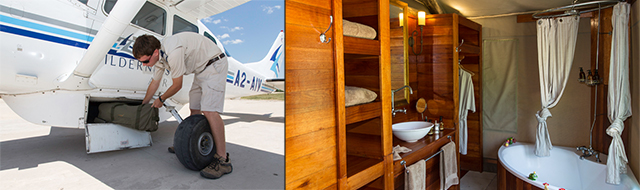
- Luggage: One small soft zippered tote bag or knapsack in a neutral color to “carry on” (and take on activities if you need a bag); one larger soft bag without wheels to “check in”. Please note that luggage pods on charter aircraft are very small and the bags must be manipulated in order to fit. Any hard side on your luggage makes this more difficult and you may have to sit with the bag on your lap in the plane, or purchase a duffel from the air charter company. Please see introductory paragraph for luggage recommendations.
- While Ziploc bags are convenient for storing toiletries and other items, plastic bags are banned in most African countries as part of an initiative to “go green.” We therefore recommend the TSA-approved clear toiletry bags by ALINK (or similar), available at: Amazon.
- Luggage tags: Please remember to put name/address tags on every piece of checked and carry-on luggage.
- Camera(s) and padded bag (+ lens cloth, batteries, re-charger and other relevant equipment).
- OVERLAND SAFARIS and RWANDA: Lightweight flashlight (a plastic disposable one is a good choice).
- Small travel alarm clock (or wristwatch with alarm) - although on safari you will generally be woken by your guide.
- Good quality, dark, non-mirrored sunglasses with UVA/UVB protection, a cord to hang them around your neck when taking pictures/using binoculars, and a hard case to store them in. Wrap-around or aviator styles (such as Ray Bans) work best. You might want to pack a back-up pair. If you wear contact lenses you should bring a pair of eyeglasses to use if your eyes become irritated. If you wear eyeglasses, you should take an extra pair with you, in a hard case.
Clothing for Safari
- A flexible hat in a neutral color with at least a 4-inch brim that can be fastened under your chin and rolled up for packing. A baseball hat is a poor choice as your ears and neck may burn. Try Tilley for several hat options.
- Name of women Traveler(s) [delete if only men]: A large square silk scarf to wrap around your neck and/or head for windy conditions. A pashmina-type shawl could also be used for this purpose (if cool), as well for covering your shoulders at dinner.
- Cotton underwear. Ladies should consider a sports bra for bumpy roads.
- SEP-MAY: 1 pair of cotton or linen trousers (heavyweight for Rwanda to protect against stinging nettles). 2 pairs of cotton or linen Bermuda shorts (so that your skin doesn’t touch the vinyl Landrover seats). Ladies might substitute one pair of shorts with a cotton or linen knee-length skirt, which can be worn in camp during the day, when travelling between destinations, or touring the towns and cities.
- JUN-AUG: 2 pairs of cotton trousers (one pair should be heavyweight for Rwanda to protect against stinging nettles). 1 pair of cotton Bermuda shorts (so that your skin doesn’t touch the vinyl Landrover seats). Ladies might substitute one pair of shorts with a cotton or linen knee-length skirt, which can be worn in camp during the day, when travelling between destinations, or touring the towns and cities.
- A sturdy brown (or neutral colored) leather or canvas belt. Make sure the buckle is not too shiny if you will be walking in the bush.
- 3 cotton shirts in neutral colors. These can be traditional safari shirts, t-shirts or polo shirts – long and/or short sleeve. Consider taking at least one long-sleeve button-front shirt to shield you from the sun. (and protect you from stinging nettles in Rwanda).
- Something to sleep in. Bathrobes are provided at most lodges and hotels. Warm duvets and hot water bottles are generally provided in cooler months. JUN-AUG: If you tend to get cold very easily bring some lightweight long underwear with you for night activities (silk works well).
- A swimsuit
- A lightweight wool sweater or fleece in a neutral color.
- RWANDA: Garden gloves to protect against stinging nettles.
- A safari jacket or vest is a nice addition to your bush wardrobe, and has lots of useful pockets, but is not necessary. TravelSmith makes a good unisex safari jacket.
- SEP-MAR A lightweight waterproof “windbreaker” in a neutral color, (in case of rain in the bush OR while hiking in the rainforest in Rwanda). Gortex is a good waterproof, yet breathable, material.
- JUN-AUG (or if going to Ngorongoro Crater) A lightly insulated waterproof jacket, in a neutral color (this can also be used to protect against the spray at Victoria Falls/rain in the Cape/ while hiking in the rainforest in Rwanda). Goose down and Thinsulate are both good lightweight insulators. Gortex is a good waterproof, yet breathable, material. Consider bringing wool gloves and a hat for morning/evening activities.
- MAY: A lightly insulated waterproof jacket, in a neutral color (this can also be used to protect against the spray at Victoria Falls OR while hiking in the rainforest in Rwanda). Goose down and Thinsulate are both good lightweight insulators. Gortex is a good waterproof, yet breathable, material. Consider bringing lightweight wool gloves and a hat for morning/evening activities.
Dinner attire in the bush
Although dinner is not formal, we find it is nice to change out of bush attire at the end of the day.
- Name of women Traveler(s) [delete if only men]: Consider a wrinkle-resistant dress or trousers and a pair of lightweight flat shoes, such as ballet flats. Please be sure to apply mosquito repellant to exposed parts of your skin. Bring your sweater and/or pashmina to dinner if it is chilly.
- Name of men Traveler(s) JUN-AUG: A pair of neutral-colored trousers, a long-sleeved Oxford-style shirt, and your safari boots or sandals will work well. Remember mosquito repellant if you don’t wear socks. Bring your sweater if needed.
- Name of men Traveler(s) SEP-MAY A pair of neutral-colored trousers, a short sleeved polo-style shirt, and your safari boots or sandals will work well. Remember mosquito repellant if you don’t wear socks. Bring your sweater if needed.
The same outfits can also be worn for dinner in the towns and cities.
Jewelry
Keep it simple! Although it is good policy to avoid wearing flashy expensive jewelry in the bush (for practical reasons) and in African towns and cities (to avoid crime), it is perfectly fine to wear a wedding ring. In addition, we’d suggest ladies choose only one pair of secure earrings and one necklace and wear them day and night throughout their trip. If you wear a watch, it should be sturdy and preferably waterproof.
For Rovos Rail
- ?: You may wish to add another more formal light weight wrinkle-resistant dress, stockings and dressier shoes.
- ?: Perhaps add one more pair of trousers (or wear your khaki ones if appropriate), a tie or ascot/cravat, and another long sleeved shirt. Consider adding a wrinkle-resistant blazer or sport coat (although this is not required on Rovos trains), and possibly some dressier shoes.
For the Blue Train
- ?: You may wish to add another more formal light weight wrinkle-resistant dress, stockings and dressier shoes.
- ?: Perhaps add one more pair of trousers (or wear your khaki ones if appropriate), a tie or ascot/cravat, another long sleeved dress shirt, socks, a wrinkle-resistant blazer or sport coat (although this is not required on the Blue Trains), and possibly some dressier shoes.
Footwear
- Comfortable lightweight hiking boots, shoes or sneakers for walking in the bush and touring the towns and cities. Russell Moccasin makes very good lightweight over-the-ankle safari boots. Consider gaiters if you will be wearing shorts on walks, so that thorns don’t stick to your socks or scratch your legs. RWANDA (delete above sentence and use: Visitors to Rwanda should bring gaiters for walking in the rainforest to protect against stinging nettles.
- Sturdy waterproof sandals for wearing around camp, possibly boating, and on game drives when you will not be walking in the bush, such as Tevas.
- If you have sufficient weight allowance, one pair of lightweight shoes for dinner in the bush and other legs of your journey.
- Please note that high heels are completely impractical and not allowed in most safari camps.
- 4 pairs of socks to wear with your hiking boots or shoes, in a natural fabric. Lightweight wool works well, as it is soft and insulates against both heat and cold.
Many of the above items can be found at your local outdoor outfitters or army-navy store. On-line shopping resources for safari include: